Why we Should use BYOD to Help Provide 1:1 Device Accessibility
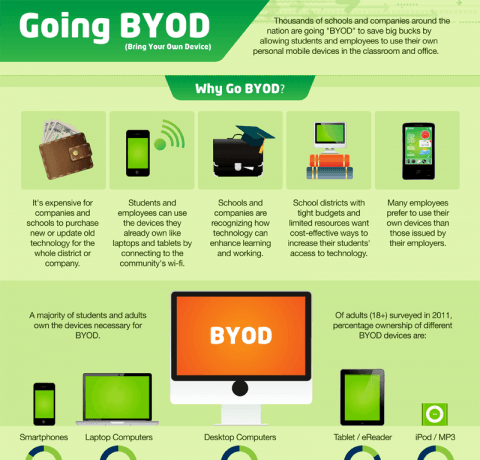
Covid 19, has been an eye opener for educators around the world. We have noticed how Common Core isn't so common. Teachers and districts around the world struggled to find ways for their kids to work so that they would have equitable access. In a recent E-Panel interview,done by my professor in EDL 621, I noted that certain school systems such as Hoover and Auburn were able to pull 1:1 and have all students work online. Other districts, such as Jefferson County and Birmingham City, just did not have the funding for such. So, what is a solution to the budgeting problem? One to One devices! It is no longer in the best interest of our students to all have to use the same type of device. Using multiple devices challenge teachers to really think about their lessons and how they are using technology. Teachers are free to explore innovative and engaging ways to reach ALL students (Paquette, 2012). Here are some reasons we should consider BYOD for 1:1 access:
Immediate Feedback- Having BYOB allows you to use clouds such as Google Suites for Education which allows you to both monitor what students are doing. It also allows for student to student collaboration and student to teacher collaboration.
Increased Engagement-Various studies have been done to show 1:1 technology increases student engagement. Teachers believe digital tools are “generally facilitating teens’ personal expression and creativity, broadening the audience for their written materials, and encouraging teens to write more (Levin & Schrum, 2015).

Student Achievement:
- Such studies tend also to focus primarily on student achievement and engagement as outcome measures of interest (Lamb & Weiner, 2018)
- 1:1 programs can enhance achievement across the curriculum (Lamb & Weiner, 2018)
- 1:1 programs can decrease achievement gaps between socioeconomic groups and learning abilities (Lamb & Weiner, 2018)
We all know that the main issue when it comes to acquiring 1:1 devices is the budget constraint on most schools. BYOD is reported as benefiting schools through relieving the cost pressure for one-to-one technology provision (Cardoza and Tunks, 2014) and providing relief for technology support (Nelson, 2012).
How to Manage and Plan for BYOD
BYOD is an innovative approach to providing digital access to all students but it must be planned for.Whitehead (2013) shared, “Understanding the value of educational technology is a major step towards developing 21st-century learning in our public and private schools.”
Below is a video that gives details on how to execute BYOD at your school.
Resources:
Cardoza Y., Tunks J. (2014). The bring your own technology initiative: an examination of teachers'
adoption. Comput. Schools 31, 293–315. 10.1080/07380569.2014.967626 [CrossRef] [Google Scholar]
adoption. Comput. Schools 31, 293–315. 10.1080/07380569.2014.967626 [CrossRef] [Google Scholar]
Lamb, A., & Weiner, J. (2018). Extending the Research on 1:1 Technology Integration in Middle
Schools: A Call for Using Institutional Theory in Educational Technology Research. Middle Grades
Review, 4(1). Retrieved from https://files.eric.ed.gov/fulltext/EJ1175684.pdf
Schools: A Call for Using Institutional Theory in Educational Technology Research. Middle Grades
Review, 4(1). Retrieved from https://files.eric.ed.gov/fulltext/EJ1175684.pdf
Levin, B. B., & Schrum, L. (2015). Leading 21st-Century Schools: Harnessing Technology for
Engagement and Achievement. Corwin Press.
Engagement and Achievement. Corwin Press.
Paquette, A. (2012, December 4). Challenging the Model of 1:1 with BYOD. Retrieved from
https://www.edutopia.org/blog/challenging-one-to-one-model-amanda-paquette
Whitehead, B. M., Jensen, D., & Boschee, F. (2013). Planning for technology: a guide for school administrators, technology coordinators, and curriculum leaders. Thousand Oaks, CA: Corwin, a Sage Company.
https://www.edutopia.org/blog/challenging-one-to-one-model-amanda-paquette
Whitehead, B. M., Jensen, D., & Boschee, F. (2013). Planning for technology: a guide for school administrators, technology coordinators, and curriculum leaders. Thousand Oaks, CA: Corwin, a Sage Company.

I agree with you in the fact that Covid-19 has introduced a forced, new way of teaching. With students learning remotely and teachers providing online instruction, there has been an adjustment for everyone, including parents. I agree that this has demonstrated the need for 1:1 devices as it has introduced a new way of teaching and learning that I think will be a permanent, alternate form of instruction in the future, now that we know it can be done. As Whitehead et al,. (2013) state "the role of digital learning in schools is tremendously exciting and is sparking a creative innovations with instructional methodologies" (p. 3).
ReplyDeleteReference
Whitehead, B. M., Jensen, D., & Boschee, F. (2013). Planning for technology: a guide for school administrators, technology coordinators, and curriculum leaders. Thousand oaks: Corwin sage. [p98ewertyuiop[3
I only wish there was a better way to manage BYOD. We used that when I was assistant principal. Without 100% buy-in from all of the teachers on management, it becomes an issue of just allowing cell phones in class.
ReplyDelete